Are Cheap Sunglasses Bad for Your Eyes? UV400, Tint, and the Dilation Trap
Tint and UV protection are two different jobs, done by two different parts of a lens — and only one of them matters to your eyes. A dark lens with no UV filter can leave you worse off than wearing nothing, while a $15 pair with the right label is doing everything a $300 pair does for your eyes' safety. The label takes five seconds to read.
PUBLISHED 2026-08 · REVISED —
At a glance
- Read the label first: it must say 100% UVA and UVB or UV400. That is the entire safety question; price is not part of it.
- Never judge protection by darkness. Tint controls brightness; the UV filter is invisible and can sit in a completely clear lens.
- Refuse a dark lens with no UV claim — it switches off your natural defences while blocking nothing that matters.
- Treat “polarized” as a comfort feature, not protection. It kills glare; it says nothing about UV.
- Prefer large or wraparound frames — UV can reach the eye past the edges of small lenses.
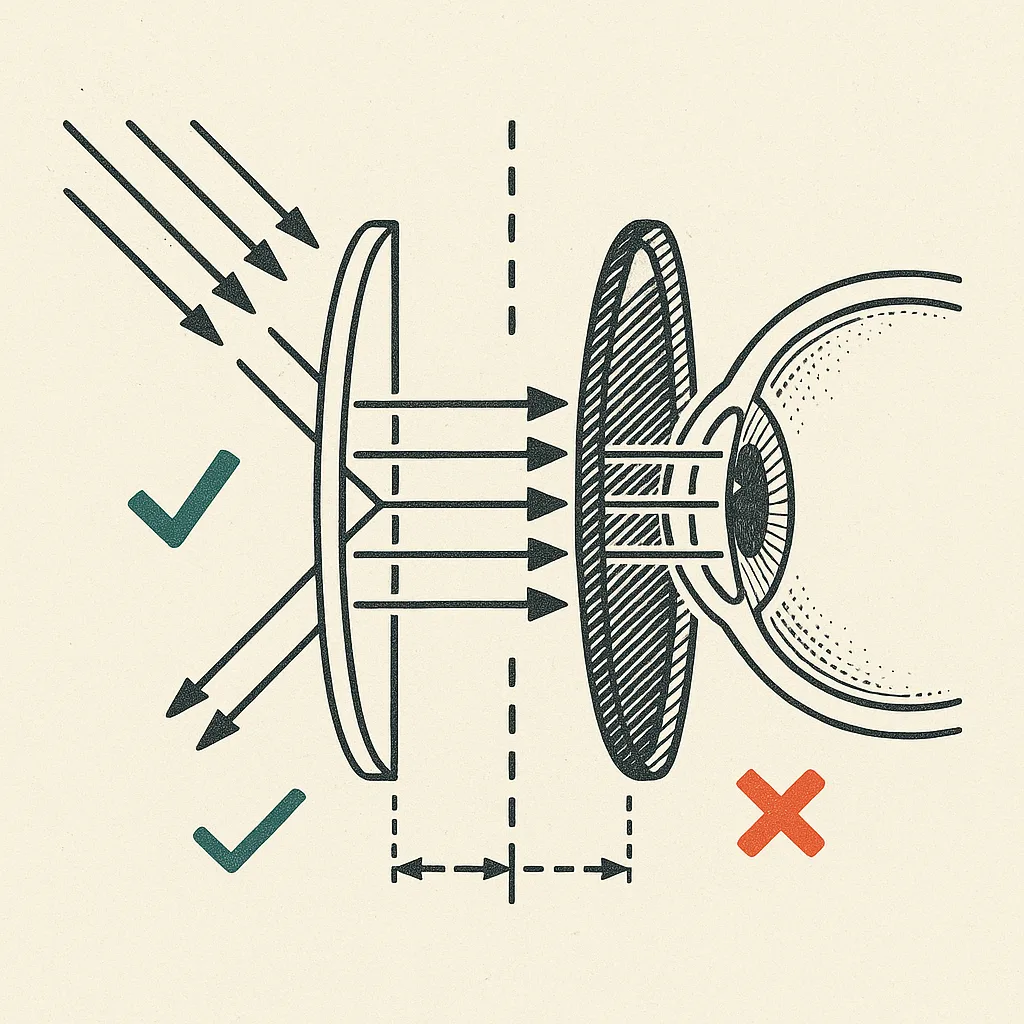
The intuition almost everyone shops with is that darkness equals protection: the blacker the lens, the safer the eye. It is exactly wrong, and it is wrong in the one way that costs money and eyesight at the same time. The American Academy of Ophthalmology — the professional body for eye surgeons in the United States — puts the correction plainly: only sunglasses with 100% UV protection provide the safety you need, and darkness on its own provides none of it. Meanwhile the same body's advice on price runs the other direction from instinct: drugstore sunglasses labelled as 100% UV-blocking are a better choice than designer sunglasses with no protection.
So the honest answer to “are cheap sunglasses bad for your eyes?” is: the price tag has nothing to do with it. A cheap pair with the right label is safe. An expensive pair with no UV data is a fashion object. And a dark pair with no UV filter — at any price — is the one configuration that can leave your eyes worse off than wearing nothing at all. This article explains why, what the one non-negotiable label means, and what polarization actually does, since that word gets sold as protection and isn't.
01Tint and UV protection are different jobs
A sunglasses lens does two separable things. The tint absorbs visible light — the brightness you can see — and its only real job is comfort: less squinting, less glare-fatigue, easier vision on a bright day. The UV filter absorbs ultraviolet light, the band of wavelengths from roughly 280 to 400 nanometres that you cannot see at all: UVB from 280 to 315 nm, UVA from 315 nm up. UV is what actually damages the eye's surface, lens, and surrounding skin over time. The two jobs are done by different mechanisms — the tint by dyes in or on the lens, the UV filter by the lens material itself or a coating — and neither implies the other in any way.
That independence is the whole story. A completely clear lens can block 100% of UV; every reputable prescription lens does. And a nearly black lens can block none of it, because the dyes that absorb visible light do not necessarily absorb ultraviolet. Your eye cannot audit any of this: UV is invisible, so a lens that passes all of it looks identical to one that stops all of it. The only instrument a shopper has is the label — which is why the label, not the darkness and not the price, is the one thing this article will keep returning to.
02The dilation trap — worse than no sunglasses at all
Here is the counterintuitive part, and the reason an unlabelled dark pair is not merely useless but actively harmful. Your eyes defend themselves against bright light automatically: the pupil constricts to a pinhole, and you squint, narrowing the cone of light that can reach the eye at all. Put on a dark lens and the world dims, so both defences stand down — the pupil opens and the squint relaxes. Behind a lens that also blocks UV, that is fine; the filter has taken over the job. Behind a dark lens that blocks only visible light, you have dimmed the part of sunlight that triggers the defences while leaving the damaging part untouched. The eye reacts to the tint as though you are in a dim room — the image the eye-care network NVISION uses — and a 2024 study in Scientific Reports, taken up in detail below, calculates that the opened-up eye can indeed end up with a higher UV dose than it would have taken bare.
The mechanism is usually told as a pupil story — hence “the dilation trap” — and it is worth being precise about what the physics actually shows, because that Scientific Reports study measured it. Modelling UV influx through 214 sunglasses lenses across the standard tint categories, the authors found the pupil's contribution is real but modest: behind dark lenses the pupil's area grows by a factor of roughly 1.2 to 1.5. The dominant factor turned out to be the squint. Relaxing it widens the eye's effective field of view so much that its contribution exceeded the pupil's by up to about 314% — and by the study's calculation, a lens transmitting too much UVA (blocking less than about 86% of it) can indeed leave the eye with a higher UV dose than no sunglasses at all. So the folk explanation gets a detail wrong and the conclusion right: dark tint without UV blocking really is worse than nothing. Your face simply stops defending eyes it believes are in the shade.
Red flag Novelty and toy sunglasses, market-stall pairs, and costume lenses with no UV statement anywhere. Dark enough to relax every natural defence, filtered enough to stop nothing — the worst pair of sunglasses is not the cheapest one, it is the unlabelled one.
03UV400: the one label that is non-negotiable
The fix costs nothing and takes five seconds. Look for one of two equivalent statements on the sticker, the temple arm, or the product listing: blocks 100% of UVA and UVB (some labels say 99–100%), or UV400. UV400 means the lens absorbs ultraviolet at every wavelength up to 400 nanometres — the top of the UVA band — which is why the American Academy of Ophthalmology treats “UV absorption up to 400nm” and “100% UV protection” as the same promise.
There is a named benchmark behind these labels. In the United States, nonprescription sunglasses and fashion eyewear are covered by ANSI Z80.3, the American National Standard that sets requirements for lens transmittance — including limits on how much UVA (315–380 nm) and UVB (280–315 nm) a lens may pass — alongside optical quality and impact resistance, the last of which is separately required by the US Food and Drug Administration. (The standard's UVA band stops at 380 nm; a UV400 lens keeps absorbing all the way to 400 nm, which is why the label meets the standard with room to spare.) The details matter less to a shopper than the fact that a real standard exists: “UV400” is not marketing poetry, it is a measurable claim a laboratory can check with a spectrophotometer.
Green flag A petrol-station or pharmacy pair whose tag reads “100% UVA/UVB — UV400”. UV-absorbing lens material is genuinely inexpensive, which is why full protection routinely turns up on pairs costing less than lunch. Per the AAO, that labelled cheap pair beats an unlabelled designer pair — the extra money buys optics, durability, and the name on the arm, not safety.
Two honest caveats. First, a label is a manufacturer's claim, and claims are only as good as the seller behind them: a counterfeit or a disposable storefront can print anything, which is one more reason to run the checks in the scam-store guide before trusting a listing's specifications. From a pharmacy, a supermarket, or any brand with a return address, the label is a regulated product claim and reasonable to rely on. Second, if a pair you already own carries no marking at all, some optical shops can check its UV transmission in a minute with a UV light meter — worth asking before a beach holiday, and the measurement settles the question the way no amount of squinting at the lens colour can.
04What UV actually does to eyes — and when it's present
The reason the label is non-negotiable is that UV damage to the eye is cumulative, slow, and mostly irreversible. The AAO's patient guidance connects long-term sun exposure to cataracts — clouding of the eye's internal lens — and to cancers of the eye, both of which can take years to develop, with risk added on every unprotected exposure. Faster and more visible are growths on the eye's surface such as pterygium, which can begin appearing in a person's teens or twenties, especially in people who work outdoors. And there is an acute injury too: photokeratitis, the corneal sunburn known as snow blindness, caused by strong UV reflecting off snow, ice, sand, or water.
The exposure map is broader than the beach. UV passes through haze and cloud, so an overcast sky is not protection; intensity peaks from midday to early afternoon, rises with altitude, and multiplies near reflective surfaces — which is why skiers and fishermen have the classic occupational eye complaints. This is also the argument for frame size: lens area is coverage, and rays arriving over and around a small lens miss the filter entirely. The AAO recommends large or wraparound styles for exactly this reason, and the literature the 2024 Scientific Reports study reviews points the same way — peripheral rays entering past frames without side coverage can focus onto the lens of the eye (the Coroneo effect).
05Polarized vs. non-polarized — what the filter actually does
Polarization is the most oversold word in the sunglasses aisle, so it earns a full section. A polarized lens carries a filter of long molecules aligned in one direction — picture microscopic window blinds, slats vertical. Light bouncing off a flat horizontal surface (water, wet tarmac, a bonnet, snow) comes away vibrating mostly horizontally; that organised horizontal light is what you experience as glare. The vertical “blinds” stop it while letting ordinary, unorganised light through. The idea is old and proven — polarized eyewear dates to 1936, adapted from a Polaroid camera filter — and the effect is real and dramatic: the white sheet of reflection on water or road surface simply switches off, which is why anglers can see fish beneath a surface that would otherwise be a mirror.
Where does that help? Anywhere glare is the problem: fishing and anything on water, bright-day driving among windscreens and chrome, the beach, road cycling and running on wet or sunlit tarmac. Where does it hurt? Anywhere you need to read a screen or judge a reflective surface. LCD displays emit polarized light, so a polarized lens can dim or black them out at certain angles — phone screens, sat-navs, petrol-pump and cash-machine displays, some car dashboards. Pilots conventionally avoid polarized lenses for exactly this reason, and skiers should note the subtler version: the glint that identifies a patch of ice is glare, and a filter that deletes glare deletes the warning. Some wearers also report altered depth perception. None of this makes polarization bad — it makes it a tool with use-cases, summarised well in the enthusiast community's own Oakley Forum guide, which is refreshingly frank that non-polarized lenses are the better choice for flying, golf, and screen-heavy days.
The claim
“POLARIZED LENSES — FULL PROTECTION FOR YOUR EYES.”
The fact
“Polarization itself does not provide UV protection,” per the American Academy of Ophthalmology. The polarizing filter manages visible glare; the UV filter is a separate property, and a polarized lens must still carry its own 100% UVA/UVB or UV400 marking.
The correction that matters is the one in the box above: polarization is a comfort and visibility technology, not a safety one. Marketing conflates the two constantly, because “polarized” is the feature shoppers have heard of and it reads like protection. In practice most decent polarized pairs also block UV — but the causation runs through the manufacturer choosing to do both, not through the polarizing film itself. Check the UV label on a polarized pair exactly as you would on any other. A cheap non-polarized UV400 pair protects your eyes; a polarized pair without a UV claim is a glare filter strapped to an open door.
06The in-hand check, in priority order
Everything above compresses to a routine you can run at a pharmacy rack in under a minute. The label is first because it is the only safety item; everything after it is comfort and optics. On optics, the AAO suggests a rack test anyone can do: hold the glasses at a comfortable distance from your face, cover one eye, and look through one lens at something with a rectangular pattern — a tiled floor works — moving the lens side to side, then up and down. If the lines sway, bow, or step, the lens has optical distortion; put it back. For sport, prefer polycarbonate lenses, which resist impact far better than ordinary plastic. Most of the method in this article comes from the AAO's patient guidance, with the standards detail and the 2024 physics filled in around it — there is more on how we read sources in how we work.
The checklist — the five-second label check, plus the minute after it
- Read the label. It must say 100% UVA and UVB or UV400. No label, no purchase — at any price and any darkness.
- Ignore tint darkness as a safety signal. Choose darkness for comfort only, once the UV box is ticked.
- Treat “polarized” as a separate question: useful for water, driving, and glare; unhelpful for screens, flying, and reading ice. It is not UV protection.
- Prefer larger lenses or wraparound frames; UV that arrives past the frame edge was never filtered.
- Run the rectangular-pattern test for distortion, and pick polycarbonate if the glasses are for sport.
- Buying online? Check the seller before trusting the specification — a printed claim is only as honest as the shop printing it.
The anti-snob conclusion bears repeating because it is the rare consumer question with a clean answer. Cheap sunglasses are not bad for your eyes; unlabelled dark sunglasses are, and those are two different categories that merely overlap at the bottom of the market. The one thing your eyes need costs pennies to manufacture and is printed on a sticker. Look closer before you pay — in this case, at four characters: UV400.
Sources
- American Academy of Ophthalmology — How to Choose the Best Sunglasses (100% UV/UV400 labelling, tint vs. protection, drugstore vs. designer, polarization is not UV protection, lens-distortion test)
- American Academy of Ophthalmology — The Sun, UV Light and Your Eyes (cataracts, eye cancers, surface growths, snow blindness, cloud and reflection exposure)
- NVISION Eye Centers — The Dangers of Cheap Sunglasses (dilation behind dark non-UV lenses; 99–100% UVA/UVB guidance)
- Scientific Reports (2024) — Calculation of solar ultraviolet influx in the eye considering the field of view and pupillary dilation due to sunglasses (214-lens model; squint/field-of-view dominance; low-UVA lenses worse than none)
- PEL Eyewear Testing — The Essential Guide to ANSI Z80.3 Eyewear Standards (scope of the US nonprescription-sunglasses standard: UVA/UVB transmittance, optics, impact; FDA impact-resistance alignment)
- Oakley Forum — Polarized vs. Non-Polarized Sunglasses (glare mechanism, 1936 origin, use-cases and LCD/flying/skiing trade-offs)