How to Clean and Condition a Leather Handbag Without Ruining It
The safe method depends on the finish, not the stain. An aniline bag drinks whatever touches it; a pigmented bag shrugs most things off; patent is a plastic coat over the leather; suede is the leather with its fibres standing up. One drop of water tells you which one you own — and everything after that follows.
PUBLISHED 2026-08 · REVISED —
At a glance
- Identify the finish first — a drop of water on a hidden spot: darkens fast, the finish is open (aniline); beads up, it is coated (pigmented).
- The routine that does most of the work is the dullest one: empty, dust with a dry cloth, condition sparingly a few times a year.
- Stains, lowest intervention first: blot liquids, powder the oil, and touch alcohol only to ink on a coated finish — after a test spot.
- Never: alcohol or baby wipes as a general cleaner, heat drying, or soaking. Each removes something that does not come back.
- The anti-panic rule, from the tannery itself: water spots fade with wear and regular care — and most other marks respond better to time than to scrubbing.
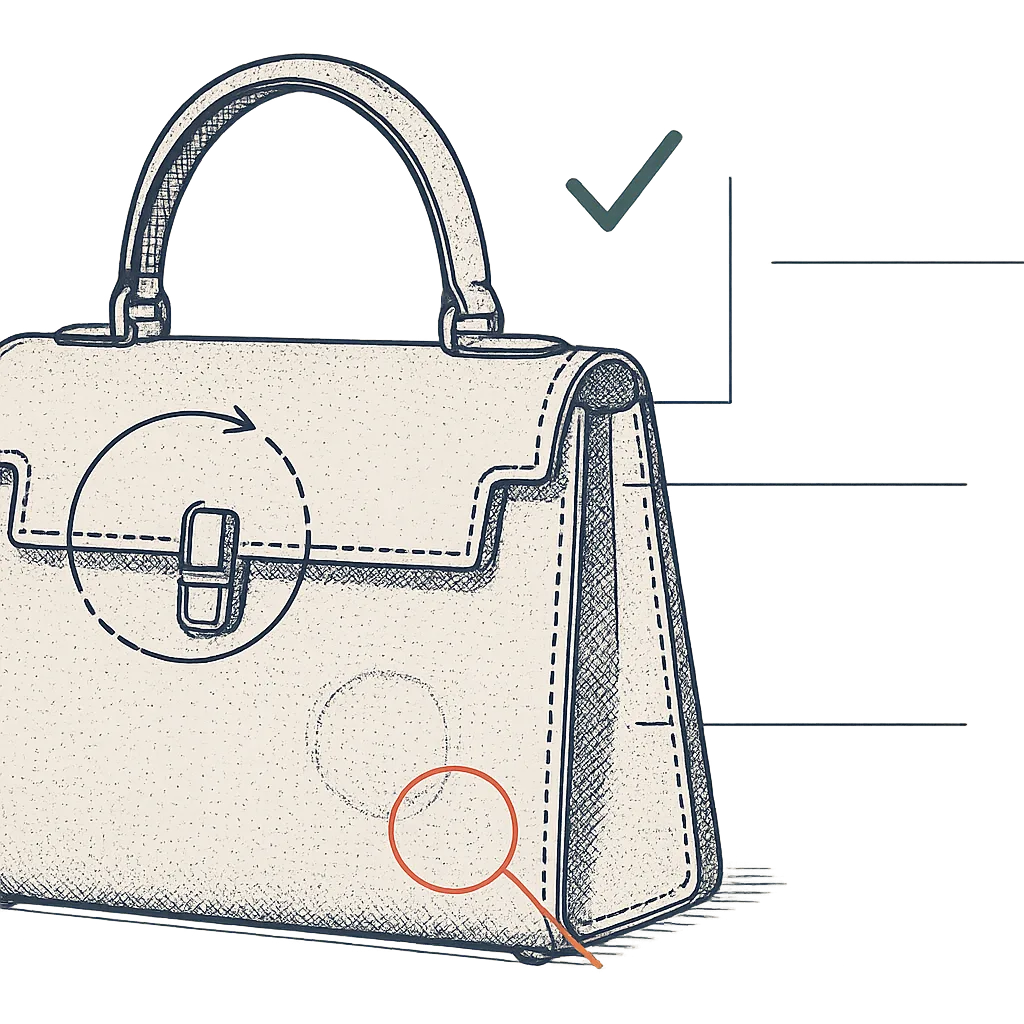
Most handbags are not ruined by spills. They are ruined by rescues: the alcohol wipe that lifted the ink and the dye with it, the hair dryer that dried a rain spot into a stiff patch. A spill sits on the surface and usually waits. A wrong cleaning method changes the material, and material damage does not wipe off.
The reason handbag advice sounds contradictory — condition it monthly, never condition it; use a damp cloth, never use water — is that "leather" is not one surface. The same hide leaves the tannery wearing very different finishes, and the finish, more than the leather underneath, decides what a bag can survive. So the first job is not cleaning. It is identification.
01Identify the finish — the one test that decides everything
Smooth leather comes in three main finishes, and the taxonomy is the tannery's own, not a marketing invention. Aniline leather is coloured with a transparent dye that soaks through the hide and is then left essentially bare: you can see the pores, the grain, the healed scars. It is the most natural-looking and softest finish — and, because nothing seals it, the most vulnerable to stains and fading. Pigmented leather is the opposite bargain: an opaque, coloured coating hides the natural grain under a uniform skin that resists stains, scratches, and sunlight far better. Semi-aniline sits between them — a light protective coat thin enough for the grain to show through. Most mid-market handbags are pigmented or semi-aniline; the price of aniline's beauty is that it behaves like a very expensive sponge.
You do not need a lab to tell them apart. Restoration specialists use a one-drop absorbency test, and it takes thirty seconds: put a single drop of water on a hidden spot — under a strap anchor, inside a gusset. If it soaks in almost at once and darkens the leather, the finish is open: treat the bag as aniline. If it beads up and sits on the surface, the leather is coated: pigmented or semi-aniline. Let the spot dry naturally either way. The other two finishes announce themselves without a test: patent is the mirror-gloss one, a sealed synthetic coating you will clean instead of the leather beneath it, and suede and nubuck are the hide with its fibres buffed up into a nap — a surface that must never be treated like smooth leather at all.
One caution while you are down there looking at pores: finish and quality are different axes. A pigmented bag can be made from excellent leather, and an aniline finish sometimes drapes mediocre hide. What the grades — full-grain, top-grain, and the trap called "genuine leather" — actually name is a separate question, covered in the leather-grades guide. This page is about keeping whichever one you own alive.
02The routine — dust and condition, and very little else
The highest-value habit is also the least dramatic one. Empty the bag, shake the crumbs out, and wipe every exterior surface with a soft, dry cloth — into the seams, under the handles, along the base, where grime settles first. Done every week or two, this removes the abrasive dust that would otherwise grind into the finish with every carry, and it is safe on every finish including aniline, which is precisely why it leads.
When dry dusting stops being enough — a film of grime, a sticky handle — the next rung is a barely damp one, and on aniline it is the last rung: a soft cloth wrung nearly dry. On coated leather you can go slightly further. Leather-goods maker Von Baer's method is a few drops of mild soap in warm water on a well-wrung cloth, wiped gently over the surface — never scrubbed — then excess moisture blotted with a dry cloth and the bag left to air dry away from heat. We add one pass of our own: a clean cloth dampened in plain water to take the soap fully off before it dries, because residue left sitting in the leather dries it out. Blot dry with a towel and let the bag finish drying on its own, at room temperature.
Then condition, because anything that lifts dirt from leather lifts some of its oils with it. A neutral leather conditioner or cream, applied sparingly with a soft cloth in small circles, put back what the cleaning took out and keeps the fibres flexible; give the handles, corners, and base extra attention, since the places hands touch most are the places the finish wears first. Frequency is lower than the product labels imply: Charles & Keith's care guidance suggests conditioning every few months as a general rule, and only once or twice a year for top-grain bags — and twice a year is the honest default for most wardrobes. "Sparingly" is not filler, either — the same guidance lists too much conditioner among the classic mistakes, alongside too much water, because over-conditioning traps oils and moisture and leaves the surface tacky.
03Stain triage — lowest intervention first
The order of operations for any stain is fixed: blot what is wet, absorb what is oily, and only then consider anything stronger — tested first on a hidden spot, every time. Escalating early is how small stains become permanent ones.
Water spots and rain rings
Blot standing water immediately with a dry cloth — do not rub it around — and let the bag dry at room temperature. On coated leather that is usually the whole story. On aniline, a drop that got a head start may dry as a darker ring, because the edge of the wet patch dries at a different rate from its centre. The counterintuitive fix comes from the tannery playbook: re-wet the whole panel evenly with a barely damp cloth so it dries as one surface rather than as a ring, then leave it alone and let time do the rest. A light conditioning once fully dry helps the surface even out. What turns a water mark permanent is almost never the water; it is the heat people apply trying to hurry it.
Oil and grease
Oil is the stain water cannot touch — wiping a greasy mark with a wet cloth just spreads it. The method every maker converges on is a dry powder that out-competes the leather for the oil: dust the mark generously with cornstarch, baking soda, or talcum powder, leave it overnight to draw the grease up out of the fibres, and brush it away gently with a soft-bristled brush in the morning. Repeat rather than rub. A fresh oil mark often lifts entirely; an old one that has had weeks to migrate into the hide may only fade — and on aniline, may simply become part of the bag's history, which Section 05 will argue is a smaller tragedy than it feels.
Ink
Ink is the emergency, the one stain where waiting costs you: it keeps migrating into the finish, and once under the surface no home method reaches it. It is also where the sharpest finish distinction applies. Both Von Baer and Charles & Keith reach for the same tool: a cotton swab with rubbing alcohol, tested on a hidden spot first, the area conditioned afterwards — Charles & Keith warns that alcohol can dry out or discolour the leather. Our advice is stricter than either: attempt it only on a coated, pigmented finish, keep the swab barely damp, touch the mark alone — not a wipe, not a cloth — and stop at the first sign of the bag's own colour on the swab. On an aniline bag, skip the attempt entirely: the colour is dye in an uncoated surface, and anything strong enough to dissolve ballpoint ink will dissolve the dye around it, trading a small blue line for a pale blotch. Aniline ink stains are a job for a professional leather cleaner, and the sooner the better.
04What never to use
Red flag Alcohol and baby wipes as a general cleaner, heat in any form — hair dryers, radiators, sunny windowsills — and soaking. Each one removes something from the leather (finish, oils, shape) that no aftercare puts back.
The banned list is short, and every entry is banned for a mechanism, not a superstition. Wipes — baby wipes, antibacterial wipes, the packet in the glovebox — are engineered for skin and worktops, and carry alcohols and cleaning agents that strip leather finishes a few microns at a time; Von Baer warns they can discolour the surface, and Charles & Keith lists ordinary wet wipes among the standard ways bags get wrecked. The targeted swab for ink in Section 03 is the sole, narrow exception, and only on a coated finish. Heat pulls water out of leather faster than the fibres can bear, and takes the oils with it: a bag dried on a radiator loses in an hour the suppleness a year of conditioning built. Room temperature, however long it takes. Soaking combines both problems — water deep in the hide, oils carried out as it leaves, and a shape that may never fully recover. Bleach and ammonia products should never meet leather at all. And the internet's favourite home brews — vinegar chief among them — belong to other materials; on a handbag finish they are an uncontrolled experiment run somewhere visible. (Shoes play by their own rules, salt stains included — those live in the shoe-cleaning guide.)
The claim
“Cleansing wipes — safe and effective on all leather.”
The fact
Bag makers put ordinary wipes on the do-not-use list: wet wipes are named among the common cleaning mistakes in Charles & Keith's care guide, and Von Baer warns wipes can discolour the surface. There is no universal leather wipe, because there is no universal leather finish.
05The anti-panic principle — most marks fade with use
Before any stronger intervention, it is worth hearing what the people who actually make leather say about marks on it. Horween, the Chicago tannery whose hides end up in some of the most expensive leather goods made, is strikingly relaxed on the subject: its care guidance for shell cordovan says water spots and rain marks fade if you simply continue using the item and keep up regular care, and that finished leather tends to improve with wear. The advice was written about shoes, but the principle is about the material, and it carries: leather is not a laminate that is perfect until scratched. It is a mat of fibres full of oils and waxes that keep slowly redistributing for the life of the object.
That redistribution is visible on oil-rich leathers as what tanners call pull-up. Horween's description of its Chromexcel leather explains the mechanism plainly: the hides are hot-stuffed with oils, waxes, and greases that are solid at room temperature, and pull-up is "the temporary displacement of these oil and wax blends that cause a lightening of the leather" — the pale bloom you see when such a bag is bent or scratched. Temporary is the operative word. Warmth and friction move the oils back: a firm rub with a thumb or a soft cloth blends most surface scratches on a leather like that back into the panel, no product involved.
So the anti-panic rule earns its place. A week-old mark is not an emergency; on most finishes it is already fading, and on an aniline bag it is becoming patina — the darkened handles and softened corners that make a ten-year-old bag look better than it did new. The interventions worth making quickly are the narrow ones already named: ink, always; standing liquid, blotted now; oil, powdered tonight. Nearly everything else responds better to dust cloth, conditioner, and time than to anything sold as a rescue.
06Suede, nubuck, and patent — the two special cases
Suede and nubuck run on inverted rules: dry methods first, water almost never. The routine clean is a suede brush, used gently with the grain to lift dust and revive the crushed nap; American Leather Co.'s suede guidance adds the reflex that saves most suede bags — when something lands on it, blot at once with a clean, dry cloth rather than wiping, which ALC warns embeds the stain deeper into the suede. Speed matters because liquid that wicks between the raised fibres and dries there tends to leave rings. Dry marks respond to a suede eraser and re-brushing. If a suede bag is properly stained, the honest options are a specialist product made for suede, a professional, or acceptance — never the soap-and-water method from Section 02, and never a smooth-leather conditioner, which flattens the nap into a dark smear.
Patent is the opposite kind of easy. The gloss is a sealed synthetic coat, so you are cleaning varnish, not hide: a soft damp cloth and a dry buff handle nearly everything, because most stains sit on the surface. Its two vulnerabilities are scratches — the coating cannot be conditioned back the way an oil-rich leather heals — and colour transfer from long contact with darker materials, a storage problem more than a cleaning one. Charles & Keith's guidance for patent is to use only products made specifically for it, never applied straight onto the bag, and always after a test on an inconspicuous spot.
07Storage — where bags quietly go wrong
Bags spend most of their lives in storage, which is where the slow damage happens: creases from being crushed, mould from trapped damp, fading from a sunny shelf. The fixes are cheap. Stuff the bag lightly with acid-free tissue or plain paper (not newspaper against a pale lining — the ink transfers), tuck chains and straps inside so the hardware cannot dent the leather, and stand it upright in its dust bag — a breathable cotton one, not a sealed plastic tub, because leather holds moisture and mould wants exactly that trapped, unmoving air. Then give it a cool, dark, ventilated spot away from direct sunlight, which aniline finishes have no coating to resist. Before a long spell in storage, condition first; a bag that goes into the cupboard supple comes out supple. And rotation is a care product in itself — a bag that rests between outings sheds the moisture it picked up and keeps its shape longer than one carried daily.
None of this requires a cabinet of potions: a soft cloth or two, a suede brush if you own suede, mild soap, cornstarch or baking soda, a neutral conditioner, a cotton dust bag. The methods above come from the parties with the least incentive to be wrong — tanneries and bag makers writing about their own material — which is the source hierarchy described in how we work.
The checklist — the twice-a-year routine
- Identify the finish once: one drop of water somewhere hidden — darkens fast means aniline (gentlest methods only), beads up means coated.
- Empty the bag, shake it out, and dust every surface and seam with a soft, dry cloth.
- If grime remains on a coated bag, wipe with mild soapy water on a well-wrung cloth, then wipe the soap fully off with a clean damp cloth and blot dry. Aniline gets a barely damp cloth at most.
- Let the bag dry completely at room temperature — no hair dryer, no radiator, no sun.
- Condition sparingly with a neutral cream in small circles, extra passes on handles, corners, and base; buff off any excess.
- Brush suede with the grain; wipe patent with a damp cloth and buff — no conditioner meant for smooth leather on either.
- Stuff lightly with tissue, tuck hardware inside, and store upright in a cotton dust bag in a cool, dark, ventilated place.
- Between routines, intervene only for the fast movers: blot spills immediately, powder oil overnight, and treat ink on coated leather with a tested cotton swab — or a professional.
Sources
- Horween Leather Company — Shell Cordovan Care
- Horween Leather Company — Chromexcel® (hot-stuffing and pull-up explained)
- Von Baer — How to Clean a Leather Purse (Properly, Without Damaging It)
- Charles & Keith — A Complete Step-by-Step Guide: How to Clean Leather Bags
- American Leather Co. — How to Clean Leather Purses & Bags
- American Leather Co. — How to Clean Suede Leather Bags
- Crest Leather — What Are the 3 Main Types of Leather Finish?
- Furniture Clinic — How to Determine the Absorbency of Leather