How to Buy Shoes Online That Actually Fit
A size number is a label, not a measurement. The brands' own conversion charts disagree with each other by up to half a centimetre — so the only number that travels between shops is the length of your foot.
PUBLISHED 2026-08 · REVISED —
At a glance
- Measure both feet in centimetres, at the end of the day — this is the one number that works in every shop.
- Use the size chart on the product page of the brand you are buying, every time. Never convert from another brand.
- Read reviews for direction and magnitude ("sized up half"), not verdicts ("true to size").
- Check the returns policy before you buy — especially before you order two sizes.
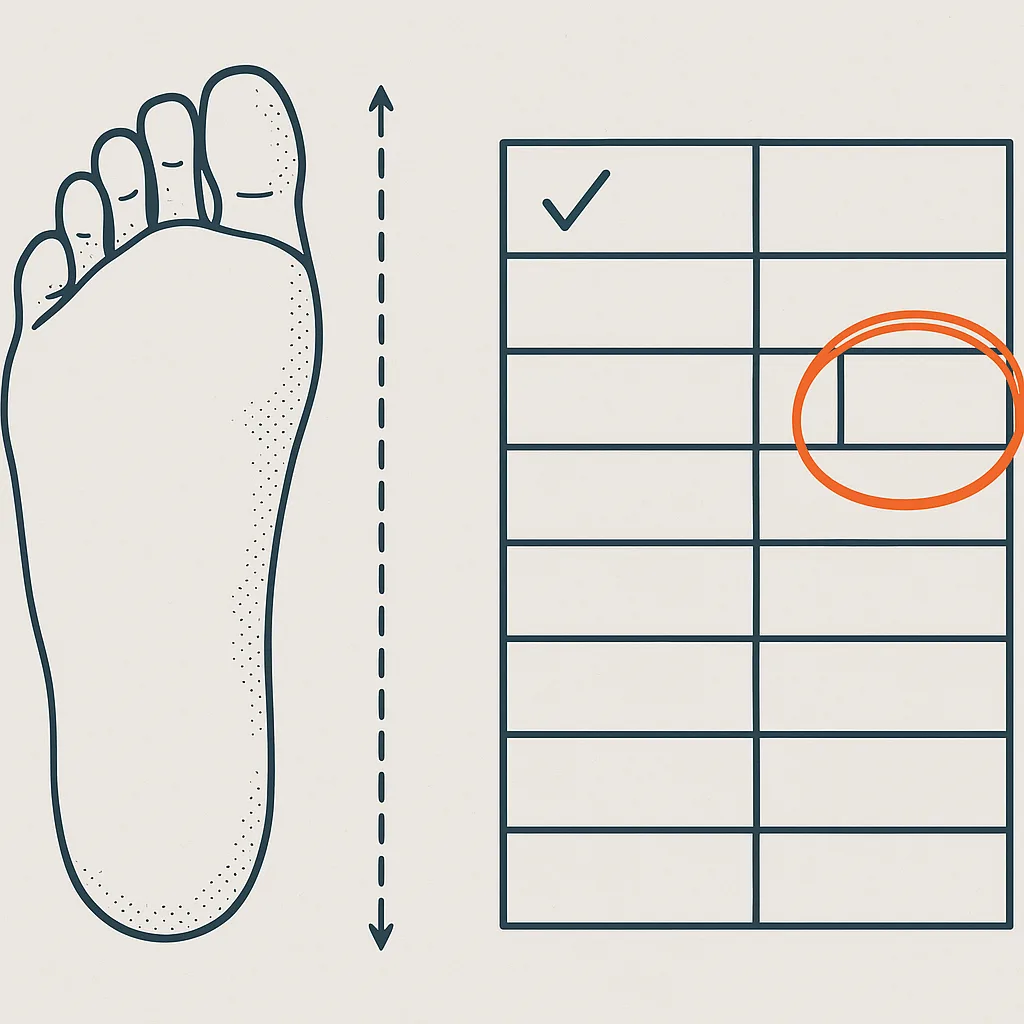
Buying shoes online means buying shoes you cannot try on, from a warehouse that has never seen your feet. Most people handle this by typing in "their size" — the number they have worn since roughly secondary school — and hoping. The evidence says hope is not working: a 2018 review in the Journal of Foot and Ankle Research found that between 63 and 72% of people were wearing shoes that did not accommodate either the length or the width of their feet, and linked the mismatch to foot pain, corns, calluses and toe deformity. That figure comes from studies that measured the shoes people were already wearing — with a shop assistant and a fitting stool at least available. Online, with no chance to feel the fit before paying, the size number is doing even more work — and it is the least trustworthy part of the whole transaction.
The fix is not a trick. It is three habits, in order: measure your feet in centimetres, translate those centimetres through the chart of the specific brand you are buying, and read the returns policy before you commit. Everything else — review-mining, ordering two sizes — is refinement on top of those three.
01There is no universal last
Every shoe is built around a last — the foot-shaped form that sets the shoe's internal length, width and volume. There is no international body that forces a "size 9" last to be any particular shape. Each brand designs its own lasts, revises them between models, and then prints a familiar number on the box. The number is a claim about which feet the shoe should fit; the last is the fact of the matter. This is the machinery behind a problem covered at length in why you're probably wearing the wrong shoe size: "your size" describes your history with one brand's lasts, not your feet.
The brands say this themselves, quietly. Nike's foot-measuring guide advises that while other brands "may use similar size scales, it's best to check out a shoe brand's size charts before purchasing a new pair of shoes from them, as each brand's exact approach to size and fit may vary." That sentence, published by the company with the strongest incentive to tell you your Nike size is all you need, is the entire argument of this article in miniature.
You can also watch the disagreement directly, because the charts are public. Set Nike's men's footwear chart beside the conversion chart ASICS publishes in its shoe size guide, and read across the same US size:
| US men's size | Nike chart (cm) | ASICS chart (cm) | Gap |
|---|---|---|---|
| 7 | 25 | 25.25 | quarter cm |
| 9 | 27 | 27 | agree |
| 10.5 | 28.5 | 28.25 | quarter cm |
| 12 | 30 | 29.5 | half cm |
As published on the two brands' own charts at the time of writing. Note the shape of the disagreement: the charts happen to agree at a US 9, drift by a quarter centimetre either side of it, and are half a centimetre apart by a 12 — and the drift is not even in a consistent direction. The European column wobbles independently: the same US 8 is an EU 41 on Nike's chart and an EU 41.5 on ASICS's. Conversion between sizing systems is not arithmetic; it is each brand publishing its own opinion. Nike's chart carries one more caveat worth knowing: "the CM size displayed on shoe boxes and labels is different than Foot Length (cm)" — so even the centimetre number printed on a box is a size label, not a measurement of anything inside the shoe.
Two consequences follow. First, never buy in a new brand by converting from a brand you know — you would be translating one opinion through another. Second, the only stable currency in this market is the actual length of your foot, which is why the next step is a tape measure, not a memory.
02Measure the foot, not the memory
Nike and ASICS publish near-identical measuring instructions, which is itself telling — the brands disagree about what a 9 is, but agree completely about how to measure a foot. The consensus method takes five minutes:
Measure at the end of the day, because feet swell as the day goes on; an evening measurement is the honest maximum. Wear the socks you intend to wear with the shoes. Stand on a piece of paper on a hard floor — standing matters, because feet lengthen and spread under body weight — with your heel lightly against a wall. Trace the outline, or have someone mark the tip of the longest toe and the back of the heel, then measure heel to toe with a ruler in centimetres. Then do the other foot: it is normal for the two to differ, and when they do, the larger foot chooses the size.
Centimetres, not inches, and not sizes. On the charts above, a half size is worth as little as a quarter of a centimetre; a ruler resolves finer than that, which means your measurement can tell you when you sit between a brand's sizes — the exact situation where guessing goes wrong. Width deserves a measurement too, or at least a moment's honesty: across the studies in the 2018 review, between 30 and 88% of participants wore shoes too narrow for their feet, with older people and people with diabetes among the groups most likely to be affected. If a standard fit has ever left pressure marks along your little toe, look for brands that publish wide fits — many do, and the option costs nothing online, where the wide version sits one dropdown away from the standard one.
Write both numbers down — length in centimetres, plus width or at least which foot is bigger — somewhere you can find at a checkout. The measurement stays valid for a year or so; feet change with age, so re-measure occasionally rather than never. The full at-home routine, including what mis-fit does to feet over time, lives in the wrong-shoe-size guide.
03Use that brand's chart — the one on the product page
Armed with a centimetre figure, the routine at a product page is short: find the size chart linked from the page itself, find your centimetres in the brand's own column, and read across to the label the brand attaches to that length. You are no longer guessing what a 9 means; you are asking the brand what it calls 27 centimetres, and brands answer that question in their charts precisely because their labels do not travel.
Three refinements make the chart reading more reliable. If your foot sits between rows, take the larger size — a shoe slightly long is wearable, a shoe short is not. If you are switching between men's and women's ranges, do not apply folklore: use the chart, since the offset is brand-specific (Nike states a 1.5-size difference between its men's and women's labels for the same foot; other brands differ). And if the product page offers widths, treat width as part of the size, not an accessory to it.
Red flag A multi-brand shop that offers one generic conversion chart for everything it sells is telling you it does not know how its own stock fits — the brands' charts disagree, so a universal chart cannot be right. A shop with no size chart at all, only a size dropdown, is a stronger warning still, and worth reading alongside the signs of a disposable storefront.
04Decode the review language
Size charts describe the brand's intention; reviews describe what arrived. The useful skill is knowing which review sentences carry information and which are noise.
The claim
“Fits true to size — order your usual size.”
The fact
"True to size" only means "true to this brand's chart". Nike's own guidance is that each brand's approach to size and fit may vary — so a reviewer's "usual size" in another brand tells you nothing unless you know both charts.
"True to size" is the weakest phrase in the vocabulary. Most reviewers have never measured their feet — recall that most people are wearing the wrong size to begin with — so "true to size" usually means "fits the way my other shoes fit", which may be to say: also wrong. Treat it as absence of complaint, not evidence of accuracy.
The phrases worth mining give you a direction and a magnitude. "Runs small — sized up half and it's perfect" is a usable data point: it tells you which way the model deviates from the brand's own chart and by how much. One such review is an anecdote; fifteen reviews agreeing on the same half-size, on the same model, is a pattern worth acting on — always at the level of the model, not the brand, because lasts change between a brand's racing shoe and its everyday trainer. "Wide toe box" and "narrow through the midfoot" are volume statements, not length statements: they matter if width is your recurring problem and are irrelevant to which number you order. And weight reviews by specificity — "I measure 26.5 cm and the 9 fits with room" is worth ten of "great shoes, fast shipping".
Where a retailer publishes an aggregate — a little meter saying 60% of buyers found the model large — prefer it to any individual comment; it is the same pattern-reading done for you at sample sizes no comment section reaches.
05Read the returns policy before you order two sizes
The standard advice for between-sizes feet is to order both candidates and send one back. It is good advice with a dependency: it assumes the return is free, simple and actually available — and outside the EU and UK, where distance-selling law grants a 14-day right of withdrawal, returns are governed entirely by the shop's policy. Even where the statutory right exists, the shop can make you pay the return postage — so the policy page still decides what the two-size trick costs. Before ordering two sizes, the policy page needs to answer four questions. Does the window give you time to try both pairs? Who pays return shipping — because a fee each way can quietly cost more than the fit information is worth? Is there a restocking fee? And what condition language applies — "unworn, in original packaging" is standard and reasonable, but it means try-ons happen indoors, on carpet, tags attached, box undamaged, or the return can be refused. The returns guide walks the policy page line by line, including the patterns that convert a "free return" into a 30% haircut.
If the policy passes, the two-size order is a genuinely sound technique — it is the closest online shopping comes to a fitting room. Try both pairs late in the day, on the socks you measured in, walk on a clean indoor floor, and judge with your feet rather than the label: no pressure at the little toe, no heel lift, the longest toe clear of the front. Then return the loser promptly, inside the window, with the proof-of-postage kept until the refund lands. If the policy fails — restocking fees, paid returns both ways, a seven-day window — buy the single most probable size, or buy elsewhere. A shop that makes returns expensive has priced in the fact that shoes bought unseen often don't fit, and has decided you should carry that cost. How to weigh a store's whole checkout, not just its returns page, is the subject of the wider shop-smart strand; the sourcing behind this article, as ever, is described in how we work.
The checklist — the online shoe-order routine
- Measure both feet heel-to-toe in centimetres, standing, at the end of the day, in the socks you'll wear. Keep the larger number.
- Open the size chart on the product page of the brand you are buying. Find your centimetres; take the larger size if you fall between rows.
- Ignore any chart that isn't that brand's own — including your memory of another brand's size.
- Scan reviews for repeated direction-and-magnitude phrases about this model ("runs small, sized up half"); discount bare "true to size".
- Read the returns policy: window, who pays return shipping, restocking fees, condition terms.
- Only order two sizes if returns are genuinely free and the window is comfortable.
- Try on indoors, tags on, late in the day; return the losing pair promptly and keep proof of postage.
Sources