Why You’re Probably Wearing the Wrong Shoe Size
Peer-reviewed research puts 63–72% of people studied in shoes that don’t match the length or width of their feet. The reason is mechanical: a shoe size describes a factory form called a last, not your foot — and every brand cuts its lasts differently. The fix is a tape measure and ten minutes.
PUBLISHED 2026-08 · REVISED —
At a glance
- Measure both feet in centimetres, standing, at the end of the day — then fit the larger foot.
- Treat “your size” as a starting guess, never an answer: sizes describe lasts, and lasts differ by brand and even by model.
- Check width as well as length — in the 2018 review, the groups with wider-than-average feet were 46–81% in shoes too narrow.
- Re-measure instead of reordering by memory. Feet grow larger and wider with age; a 2010 study found 69.2% of older men in shoe sizes bigger than their measured feet.
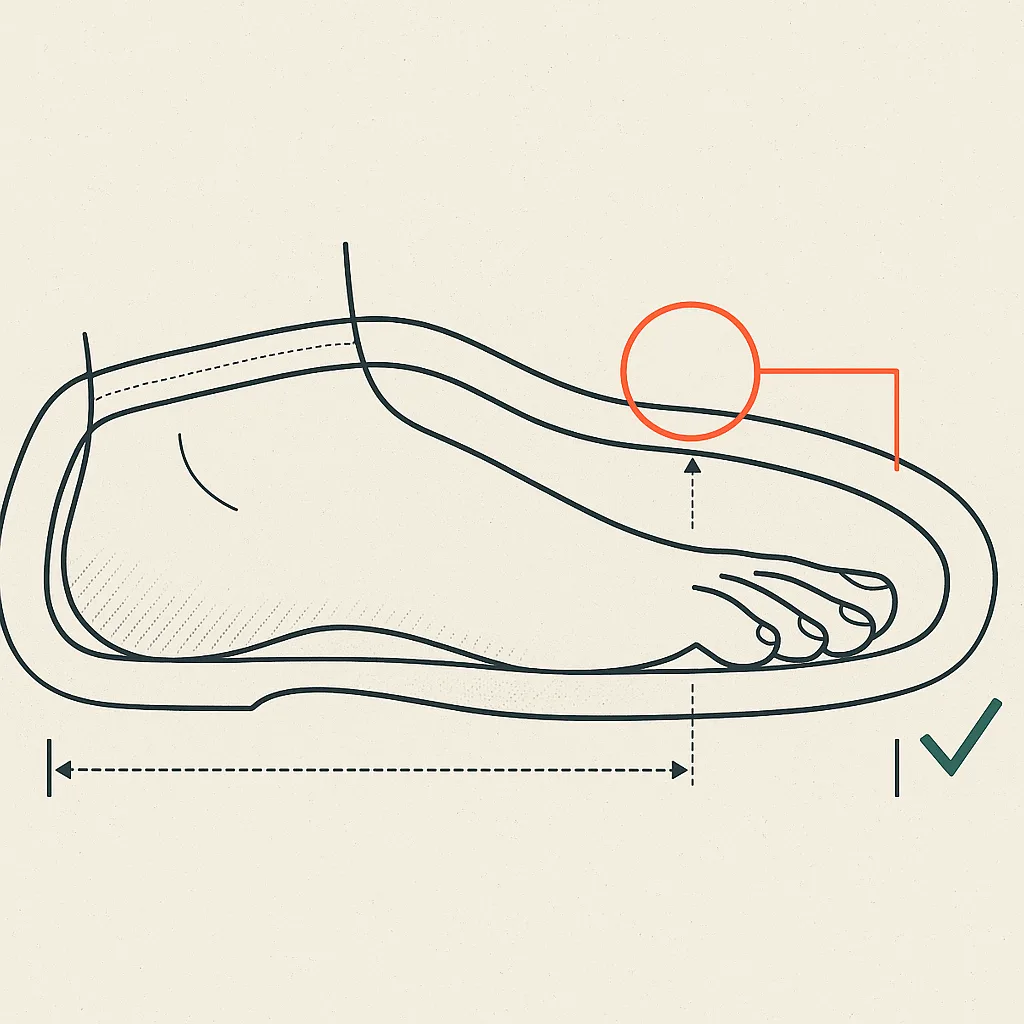
Ask a room of adults what shoe size they take and nearly everyone answers without hesitation. The number feels like a fact about the body, learned once in adolescence and carried for life, like eye colour. The research says otherwise. A 2018 systematic review in the Journal of Foot and Ankle Research, which pooled studies that measured people’s actual feet against the actual shoes they were wearing, found that between 63 and 72% of participants were in shoes that failed to accommodate either the length or the width of their feet. Not a slim minority with unusual feet — roughly two people in three, wearing the wrong shoes while feeling certain of their size.
That certainty is the problem this article is built to remove. It covers what the evidence actually found, why the mismatch rate is that high — a story about nineteenth-century units and factory woodwork more than about carelessness — what a bad fit does to feet over years, and then the correct way to measure at home: both feet, end of day, centimetres rather than sizes.
01What the evidence actually says
The 2018 review is worth reading closely because its method is the honest one: not surveys asking people whether their shoes fit (nearly everyone says yes), but studies where researchers measured feet with calipers and rulers and compared the result against the internal dimensions of the shoes those same people arrived in. Across the pooled studies, 63–72% of participants wore shoes that did not accommodate their feet in length or width — and width problems were strikingly common: in two samples of American women, 86–88% wore shoes narrower than their feet, and the groups most prone to too-narrow shoes ran 46–81%. The review’s authors ended by asking manufacturers for a wider selection of widths, “particularly in relation to foot width”, which is about as close to a complaint as a systematic review gets.
The populations studied ran from working-age adults to older people to people with diabetes, and the pattern held throughout, though it worsens with age. A 2010 cross-sectional study in the Journal of Sport Rehabilitation measured 399 adults aged 60 to 90 and found 69.2% of the men and 48.5% of the women wearing shoes longer than their feet — and, tellingly, only a single man in the entire sample wearing shoes too short. People do not drift randomly out of their size; they stay loyal to a number their feet outgrew, or pick loose shoes because loose feels safe, and end up with heel slip, bunched toes, and shoes that flex in the wrong place.
Ill fit is not only an accuracy problem. The 2018 review reports associations between incorrectly fitted footwear and foot pain, corns and calluses, and lesser toe deformities — the hammer-toe family. The starkest finding concerns people with diabetes, for whom footwear is a genuine medical issue: participants with a current foot ulcer were up to five times more likely to be wearing incorrectly fitted shoes than those without. For a diabetic foot with reduced sensation, a shoe that rubs is a wound that isn’t felt. For everyone else the stakes are lower but the mechanism is the same: feet adapt to chronic pressure slowly, quietly, and mostly irreversibly.
02The last: what your size actually describes
Here is the fact that dissolves most sizing confusion. Every mass-produced shoe is built around a last — a solid, roughly foot-shaped form, traditionally hardwood, now usually high-density plastic, over which the upper is stretched and to which the sole is attached. The last determines everything about the shoe’s interior: its length, its width at the ball, the height over the instep, the shape of the toe box, how much the heel cup grips. And the size number printed on the box describes the last, not any foot.
This matters because a last is a designed object, and designers disagree. A sleek dress-shoe last tapers hard at the toe; a trail-shoe last leaves room for feet that swell over hours; a boot last hugs the instep to keep the heel seated. Two shoes marked with the same size, built on different lasts, can differ meaningfully in internal length and dramatically in internal shape. There is no universal registry forcing a brand’s “size 9” to equal anyone else’s — or even to equal the same brand’s size 9 on a different last two seasons later. “Your size” is not a property of your foot. It is a property of a particular last, worn by your foot, once.
There is also a hidden allowance. A shoe’s internal cavity is typically built around 15 mm longer than the foot it is meant to fit, because a walking foot lengthens as it rolls through a stride and toes need room ahead of them. How much allowance a maker builds in is another private decision, and another way two same-number shoes diverge.
03Why the number drifts: barleycorns, Paris points, and marketing
The sizing systems themselves were not designed so much as inherited. A UK shoe size counts the length of the last in barleycorns — a unit of one third of an inch, kept alive from medieval measure into every British shoebox. The US system uses the same barleycorn but starts counting from a different zero, which is why US and UK numbers disagree by roughly a size for the same foot. Continental European sizes count Paris points of two-thirds of a centimetre. Three systems, three zeros, two archaic units, all describing last length rather than foot length, all coarser than the differences that make shoes comfortable or not.
The one honest system is the one almost nobody shops in: Mondopoint, used by ISO standards, ski-boot makers, and several armed forces, which labels footwear with the foot length and width it is meant to fit, in millimetres. A Mondopoint 270/100 fits a 270 mm foot, 100 mm across, and there is nothing further to interpret. The practical lesson survives translation into ordinary shopping: the millimetre or centimetre column is the only part of any brand’s size chart that refers to your actual foot. It is the column to live in.
On top of the inherited units sits commercial drift. Conversion tables between systems are approximations, and published charts routinely disagree with one another. Brands may also deviate on purpose — vanity sizing is well documented in clothing, and nothing stops a shoemaker from cutting a shade long — but the documented culprits are the units and the conversion charts themselves. None of this is a scandal, exactly. It is simply why the question “what size am I?” has no stable answer, and why the question worth asking is “how long and wide are my feet, in centimetres, today?”
The claim
“True to size — we recommend ordering your usual size.”
The fact
There is no “true” for a size to be true to. Size numbers describe each maker’s own lasts, counted in units like the barleycorn and the Paris point, with allowances and rounding that differ by brand — and the 2018 systematic review found 63–72% of the people studied in shoes that don’t match their feet. A phrase that means “order the number that already fails two-thirds of you” is not a fitting method.
04Feet change; the number doesn’t
The last reason the mismatch rate is so high is that even a size that once fit genuinely stops being true. Harvard Health’s shoe-buying guidance is blunt about it: feet change with age, usually growing longer and wider, as tendons and ligaments slacken and the arch settles. Weight change, pregnancy, and years of standing work all push in the same direction. The teenager who measured a 9 becomes the fifty-year-old buying 9s out of habit — which is precisely the loyal-to-the-old-number pattern the 2010 study caught in numbers, with most older men a size or more adrift and essentially none of them too small.
Feet also change over a single day. They swell measurably with hours of standing and walking, which is why the standard clinical advice — Harvard Health is explicit about it — is to fit shoes in the afternoon or evening, at the day’s maximum, wearing the socks you actually intend to wear. A shoe fitted to a fresh morning foot is a shoe that pinches by four o’clock. And almost nobody’s feet match each other: one is very commonly a little longer or wider, sometimes by half a size, and the correct response is always to fit the larger foot and let the smaller one live with a few spare millimetres.
05The correct home measurement
No equipment beyond a wall, a hard floor, two sheets of paper, a pencil, and a ruler or tape measure. The aim is two numbers per foot — length and width, in centimetres — taken under the conditions in which shoes are actually worn.
Timing first, because it is the highest-value detail: measure at the end of the day, in your usual socks, standing with weight on the foot being measured. Standing matters as much as timing — a loaded foot spreads and lengthens, and it is the loaded foot the shoe has to fit.
Length. Put the paper on a hard floor against the wall. Stand on it, heel touching the wall, weight even. Have someone mark the tip of the longest toe — which is not always the big toe — or, alone, mark it with the pencil held vertical. Step off and measure from the paper’s wall edge to the mark, in centimetres, to the millimetre if you can. Repeat on the other foot with the second sheet. Keep the larger number.
Width. Stand loaded again and measure straight across the widest part of the forefoot, ball joint to ball joint — either with the tape, or by marking both sides on the tracing. Keep the larger foot’s number here too. Width is the measurement shops skip and the dimension the 2018 review singled out in its conclusion, so a brand that publishes width fittings (narrow to extra-wide) is offering you real information; use it. If a shoe is too narrow, the answer is a wider fitting, never a longer shoe — sizing up for width puts the shoe’s flex point in the wrong place under your foot and adds heel slip at the back.
Then use the numbers. Take your centimetre length to the specific brand’s own chart — every serious maker publishes one — and let the chart, not memory, produce the size for that brand. Do it again, from the centimetres, for the next brand; the answers will sometimes differ, which is the system working, not failing. Expect the resulting shoe to measure roughly a centimetre and a half longer inside than your foot: that is the built-in allowance from section 02, and it should show up in the fitted shoe as about a thumb’s width — a bit over a centimetre — of space beyond the longest toe while standing. This is also the method that makes ordering shoes sight-unseen survivable; the publication’s guide to buying shoes online that actually fit builds on exactly these two numbers.
Green flag A brand that publishes its size chart in centimetres or millimetres, with a measuring method and separate width fittings, is telling you the truth the industry’s size numbers can’t. Charts that map only “US to EU to UK” with no foot length at all convert one ambiguity into another.
06Judging the shoe on your foot
The centimetres get the right box delivered; the fit check happens standing in the shoes. Toes: about a thumb’s width of room ahead of the longest toe, and no pressure across the ball. The widest part of your foot should sit in the widest part of the shoe, so the shoe creases where your foot bends. Heel: snug, with minimal lift as you walk. Walk on a hard surface, not just carpet. And ignore the number on the box in both directions — a “wrong-size” shoe that passes all of this fits, and a “your-size” shoe that fails any of it does not. Harvard’s phrasing is the right rule: trust your own comfort rather than the size or description. There is no break-in period that fixes length or width; leather relaxes a little across the width, but a shoe that presses anywhere on day one has told you what it is.
Fit is the first gate; what the shoe is built to do is the second. Once the measurement is settled, the publication’s guide to choosing the right shoes for you covers activity matching and the construction checks worth doing in the shop. The sourcing standard behind the figures in this article — medical bodies and published research over retail copy — is described in how we work.
The checklist — the ten-minute measure
- Measure at the end of the day, in the socks you’ll actually wear, standing with weight on the measured foot.
- Heel to the wall on a sheet of paper; mark the longest toe; measure heel-to-mark in centimetres. Do both feet.
- Measure width across the widest part of the forefoot, both feet, standing.
- Keep the larger foot’s numbers; the smaller foot gets the spare room.
- Convert centimetres to a size using that brand’s own chart — every brand, every time; never reuse last year’s number.
- On the foot, standing: a thumb’s width past the longest toe, no pressure across the ball, minimal heel lift. Fail any one, wrong shoe.
- Too narrow means a wider fitting, not a longer size.
- Re-measure about once a year — feet lengthen and widen with age, and the number on the box will not warn you.
Sources
- Journal of Foot and Ankle Research — Buldt & Menz, “Incorrectly fitted footwear, foot pain and foot disorders: a systematic search and narrative review of the literature” (2018)
- Journal of Sport Rehabilitation — Paiva de Castro, Rebelatto & Aurichio, “The relationship between wearing incorrectly sized shoes and foot dimensions, foot pain, and diabetes” (2010)
- Harvard Health Publishing — “10 tips for finding the right shoes”
- American Podiatric Medical Association — “How to Choose the Right Shoe” (PDF: sizes vary brand to brand; fit the larger foot; no break-in period)
- Wikipedia — “Shoe size” (sizing systems, Mondopoint, ISO/TS 19407)