Choosing the Right Shoes for You: Activity, Arch, and Construction
A shoe is a machine built for one kind of movement, and the shop wall is organised to hide that. The fix is to buy in strict priority order: fit first, because nothing rescues a wrong fit; the activity’s mechanics second; and then four physical construction checks — heel counter, twist, bend point, toe box — that take under a minute and need no equipment.
PUBLISHED 2026-08 · REVISED —
At a glance
- Fit before features: measured centimetres, end of day, fitted to the larger foot — no midsole technology rescues a shoe that’s the wrong shape.
- Match the shoe to the movement, not the label: running is repeated forward impact, walking is a rolling gait, court sports are sideways lunges — and cushioning is not lateral support.
- In the shop, run the four checks: press the heel counter, twist the shoe, find where it bends, and confirm toe room. Reject on any failure.
- Date your shoes. Midsole foam is finished around 300–500 miles — usually long before the outsole looks worn.
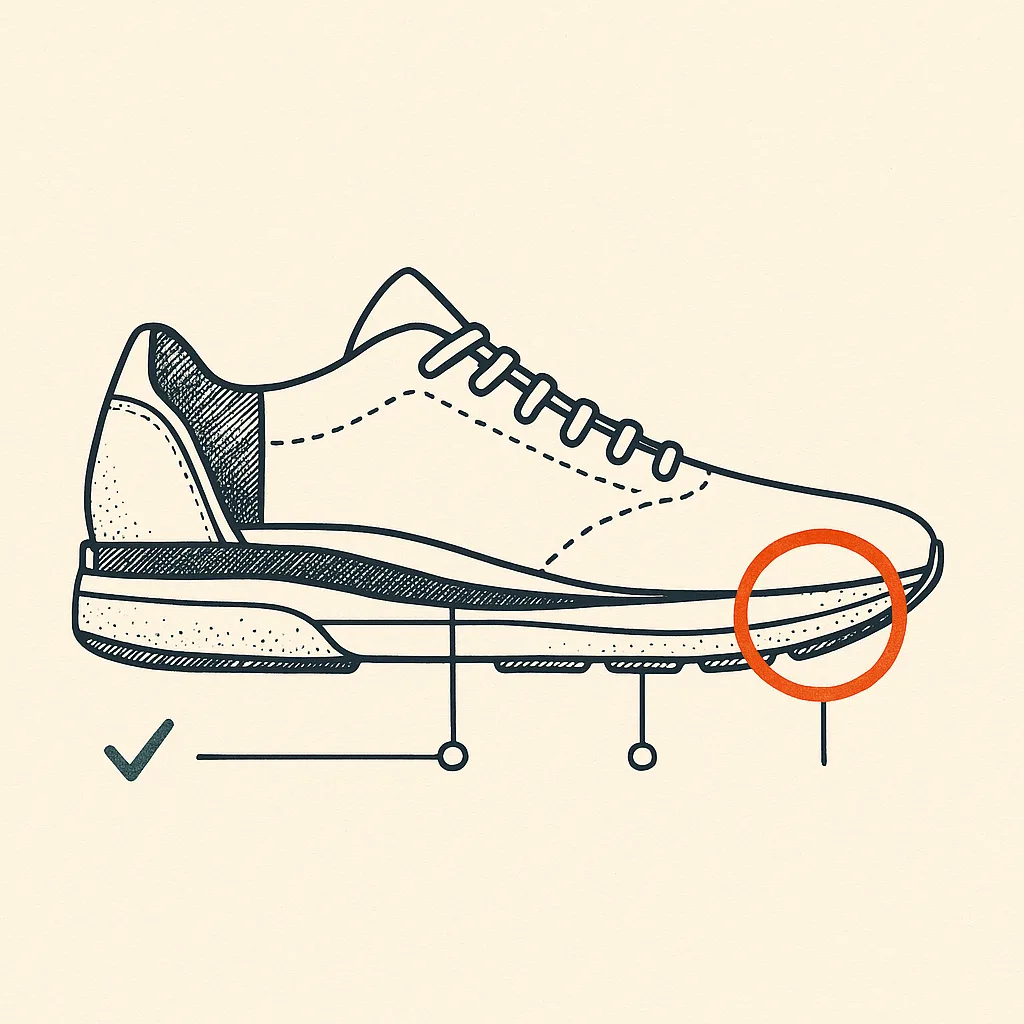
Stand in front of any shoe wall and the organising logic on display is brand, colour, and price — three properties your feet cannot detect. The properties your feet will spend a thousand hours detecting are different ones: whether the shoe’s internal shape matches your foot, whether its structure matches the movement you actually do in it, and whether the parts that do the structural work — the heel counter, the shank, the flex zone — are built to do it. None of those appear on the box. All of them can be checked in the shop, with your hands, in about a minute.
This article is that procedure, in priority order — which matters, because the checks are not equally valuable and the cheapest mistakes happen at the top. Fit is the first gate and disqualifies more shoes than everything else combined. Activity match is the second, and it is a question about mechanics, not sponsorship. The construction checks come third, as tie-breakers among shoes that passed the first two. Last comes the question nobody asks in the shop but everybody should: how you will know, in some months, that this shoe is finished.
01Fit first, because nothing else survives its failure
Every claim a shoe makes — the cushioning, the stability, the energy return — is delivered through its shape, and if the shape fights your foot, the features never arrive. A stability shoe that lets your heel float isn’t stable. A cushioned shoe that creases across your toes instead of under them is a hinge in the wrong place. Fit is not one criterion among several; it is the carrier for all the others, which is why it is the first gate and the only non-negotiable one.
The publication’s guide to why you’re probably wearing the wrong shoe size covers the evidence and the tape-measure method in full; the working summary is short. Measure both feet in centimetres, standing, at the end of the day, and fit the larger one. Bring the socks you’ll actually wear and any orthotic or insole you actually use — the American Academy of Orthopaedic Surgeons puts the socks and the end-of-day timing on its shopping list, because feet swell over hours and a shoe fitted to a morning foot pinches by evening, and the podiatric sports-medicine academy adds the orthotics: bring them along. On the foot, standing: roughly a thumb’s width of space past the longest toe (the podiatric sports-medicine academy phrases it as an index finger’s width), room to wiggle the toes, the widest part of the foot sitting in the widest part of the shoe, and a heel that stays put when you walk. A sports shoe should be comfortable immediately; “it’ll break in” is a sentence about uppers softening slightly, not about length, width, or shape changing, because they won’t.
02Match the mechanism, not the marketing
“Athletic shoe” is a category the way “vehicle” is a category. What separates a running shoe from a walking shoe from a tennis shoe is not styling but the movement each is engineered to absorb — and the differences are mechanical enough that you can reason about them from first principles.
Running has a flight phase: for a moment in every stride, both feet are off the ground, which means every landing is a small fall. Nike’s own explainer puts the arithmetic plainly — a runner drives something like two to three times body weight through each footstrike, where a walker, always keeping one foot on the ground, never leaves the ground to fall back onto it. That is why running shoes stack generous foam under the heel and forefoot, run light in the upper, and often set the heel noticeably higher than the toes in traditional designs: the whole machine is tuned to absorb repeated forward impact and give some of it back.
Walking is the same direction at a fraction of the violence. The gait rolls heel to toe, so a purpose-built walking shoe trades stacked cushioning for a smoother, flatter, more flexible forefoot that lets the roll happen. The interchangeability between the two is famously asymmetric, and the asymmetry follows from the mechanics: a running shoe is over-built for walking, which is fine — Nike’s running staff say as much — while a walking shoe is under-built for running, which is not. Cushioning designed for 1× body weight has no answer to 3×.
Court sports break the pattern entirely, because the dominant movement stops being forward. Tennis, basketball, netball, and pickleball are games of lateral lunges, hard stops, and pivots, and the shoe property that matters most is one running shoes deliberately lack: sideways stability. The American Podiatric Medical Association’s sports guidance is unambiguous — running shoes are made for high-impact forward motion and should not be used for sports built on lateral movement. Court shoes answer with thicker, stiffer soles, flatter and firmer platforms, and outsoles that grip through a pivot; basketball models add higher ankle collars for the quick changes of direction. The APMA’s working rule for all of this is usefully concrete: if you do a particular sport two to three times a week or more, wear that sport’s shoe.
Red flag Playing court sports in running shoes. A tall, soft foam stack built for straight-ahead cushioning becomes a lever under a sideways lunge — the very softness that protects a runner’s heel strike gives an ankle somewhere to roll to. Per the APMA, running shoes are for high-impact forward motion, not lateral-movement sports.
03Arch and pronation, without the mysticism
Somewhere between fit and construction sits the shoe wall’s favourite complication: arch type. It is real, but it is simpler than the posters imply. Within running shoes, the AAOS describes three broad families. Cushioned (often sold as “neutral”) shoes suit higher-arched feet, which tend to be rigid and to under-roll, so the shoe’s job is shock absorption. Stability shoes add firmer material along the inner edge of the midsole for arches that flatten and roll inward — pronation, which in moderation is not a defect but the foot’s own suspension working. Motion-control shoes are the heavy end of the same idea, for markedly flat, flexible feet that roll far enough inward to cause trouble.
Two cautions keep this honest. First, pronation is normal; it is only a problem when it is excessive and symptomatic, so a neutral, comfortable foot has no need to buy correction it doesn’t exhibit — comfort across a real walk or jog in the shop remains the best available filter. A good speciality shop will measure both feet and watch you move before recommending a category; that service is free information, and worth having. Second, arch support does not have to be welded to a particular shoe. A well-fitting shoe plus a modest over-the-counter insole is a legitimate combination — the AAPSM advises bringing any insert you use to the fitting precisely because the shoe must fit with it. What no insole or shoe category reliably fixes is persistent pain, which is a question for a podiatrist, not a shoe wall.
Green flag A shop that measures both feet, asks what you’ll actually do in the shoes, and watches you walk or jog before suggesting anything. That sequence — foot, activity, then shoe — is this article’s priority order performed as a service.
04The four construction checks, ranked
Two shoes have now passed fit and match your activity. The tie-breaker is build quality, and the useful news is that the load-bearing parts of a shoe can be interrogated by hand. Podiatric bodies teach versions of this as a standard shoe test — the APMA’s footwear guidance compresses the first three into a “1-2-3 test” — and it works on any shoe in any shop, ranked here by how much each check tells you.
First: press the heel counter. The counter is the stiffened cup moulded around the heel, and it is the shoe’s rear suspension: it keeps the heel bone vertical through thousands of landings. Squeeze it from both sides with a thumb and forefinger. It should feel firm and spring back; per the APMA, it should not collapse under the press. A counter you can fold flat with two fingers will fold sideways under a tired stride, and the heel it was meant to steady will wander with it. This check leads because the counter is structural, invisible from the outside, and the single most common place cheap construction hides.
Second: twist the shoe. Hold toe and heel and wring it gently, like a dishcloth. The APMA’s phrasing is exact: it shouldn’t twist in the middle. The midfoot is the bridge of the shoe — under your arch there are no toes to grip and no heel cup to help, so a stiffening shank in that region does the stabilising. A shoe that wrings freely through the waist delegates that work to your arch, which is precisely the structure many buyers are trying to protect.
Third: find the bend point. Push the toe upward and watch where the sole creases. The sports-medicine academy’s rule is that the shoe should bend where your foot bends — at the ball, under the toe joints — and the APMA adds the calibration: not floppy through the toe box, not rigid as a plank either. (Rocker-soled designs are the exception — they substitute a curved sole for a crease.) A shoe that folds at mid-length puts its hinge under your arch, and every step flexes the shoe against the foot instead of with it.
Fourth: read the toe box, on your foot. The first three checks work in the hand; this one needs the foot in the shoe, standing. Confirm the thumb’s width of space past the longest toe, room to wiggle all of them, and no taper pressing the little toe inward. Then a detail from the AAPSM’s checklist that costs nothing: put the shoe on a level surface and sight it from behind — the heel should sit straight, not tilted, and seams and stitching should be clean. Factory defects are rarer than flimsy counters, but they are free to catch.
The claim
“A versatile all-rounder — one shoe for running, the gym, and a bit of tennis at the weekend.”
The fact
The APMA’s guidance runs the other way: do a sport two to three times a week and you should be in that sport’s shoe — and running shoes specifically, built for high-impact forward motion, should not be used for lateral-movement sports. A shoe genuinely optimised for everything is optimised for nothing; “versatile” is a description of the marketing budget, not the midsole.
05The 300–500-mile window, and how a shoe tells you it’s done
The last part of choosing well is knowing when to choose again, because the part of the shoe that does the protecting is the part that dies first and shows it least. Midsoles are foam — most commonly EVA, ethylene-vinyl acetate — and foam cushions by trapping gas in millions of tiny cells that compress under each step and spring back between them. With mileage the cell walls fatigue and collapse, and the foam stops springing. Fleet Feet’s analogy is the right mental picture: leave a brick on a marshmallow and the marshmallow does not return to service. Crucially, this happens inside the shoe, under the insole, while the outsole rubber — chosen for abrasion resistance, not cushioning — can still look respectable. A shoe judged by its tread is a shoe judged by its least perishable part.
The numbers on this are unusually consistent. Fleet Feet puts a quality running shoe’s life at 300–500 miles — four to six months for someone running twenty miles a week; the AAPSM’s guidance says 350–500. The AAOS supplies the decay curve underneath: EVA shows its first structural damage around 120 miles and has surrendered roughly 45% of its shock absorption by 500 — degradation is a slope, not a cliff, and the range exists because load does the damaging. Heavier runners, harder surfaces, and featherweight racing foams sit at the short end; lighter runners on soft ground sit at the long end. The AAOS even offers a back-of-envelope personalisation: divide 75,000 by your body weight in pounds for a replacement mileage. For walkers the same foam physics applies at lower intensity — counting months of regular use instead of logged miles is the practical equivalent.
Since the foam won’t announce itself, use the physical signs. The shoe feels flat — the bounce is gone and landings arrive harder, which is the marshmallow stage. The tread, tire-like, has gone smooth in patches — by which point the foam above it is long past done. Wear has gone visibly uneven, which is also worth a look at your gait, not just your shoes. And the quietest sign: new, unexplained aches in feet, shins, or knees on routine distances. Any of these, or the mileage, whichever speaks first. The cheap trick that makes all of this workable is writing the purchase date inside the tongue or on the box, and keeping the retired pair for the garden rather than the run. Cleaning, for what it’s worth, keeps uppers alive — the material-by-material guide covers that — but nothing revives dead foam.
Choosing shoes, done in this order, stops being a taste test and becomes a short inspection: measurements you own, a movement you can name, four checks your hands can run, and a retirement date the shoe will confirm. Buying online shifts the fit problem to charts and returns policies — the online-fit guide handles that case — and the sourcing approach behind the figures here — medical bodies checked against retailer guidance — is described in how we work.
The checklist — the try-on protocol
- Go at the end of the day, wearing the activity’s socks, carrying any insole or orthotic you use.
- Have both feet measured, every visit; fit the larger foot.
- Name the movement before the brand: forward impact (running), rolling gait (walking), or lateral (court) — and shop only that section.
- Press the heel counter from both sides: firm, springs back, no collapse.
- Twist the shoe toe-to-heel: it should resist through the middle.
- Bend the toe upward: the crease belongs at the ball, under the toes, and nowhere else.
- On the foot, standing: a thumb’s width past the longest toe, wiggle room for all toes, widest part of foot in widest part of shoe.
- Set the shoe on a flat surface and sight from behind: heel vertical, stitching clean.
- Walk — and if it’s a running shoe, jog — on a hard floor: heel stays put, nothing presses. Comfortable now, or not bought.
- Write the date on the box or tongue; start asking questions of the shoe at 300 miles or a few months of daily use.
Sources
- American Podiatric Medical Association — “Choosing Shoes for Sports”
- American Podiatric Medical Association — footwear tips including the 1-2-3 shoe test
- American Academy of Orthopaedic Surgeons, OrthoInfo — “Athletic Shoes”
- American Academy of Podiatric Sports Medicine — “Ten Tips for Selecting an Athletic Shoe”
- Nike — “What Is the Difference Between Running & Walking Shoes?”
- Fleet Feet — “How Long Do Running Shoes Last?”
- REI Expert Advice — “How to Choose Running Shoes”